
Virtual Data Room
for secure sharing of sensitive documents
Access control, audit trail, and traceable document activity history — for M&A transactions, due diligence, and other projects where trust and transparency matter.
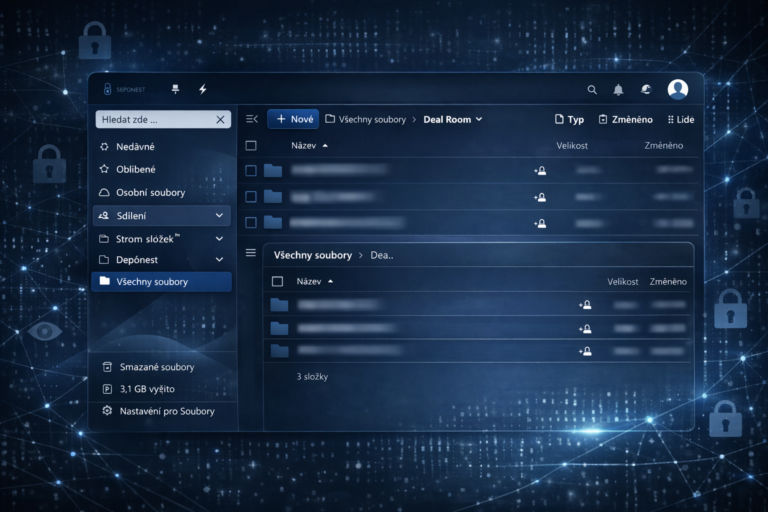
Why standard file sharing is not enough
You do not know
who opened what
Sharing without control
No audit trail
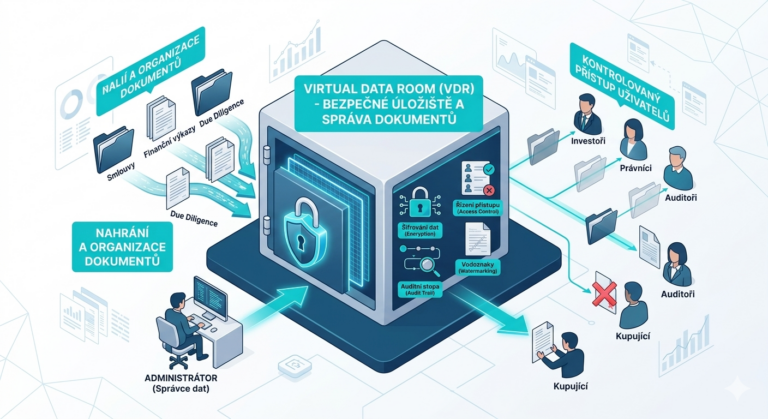
How the Virtual Data Room (VDR) works
Simply upload your documents to our secure storage with controlled access and allow selected users to view them.
We take care of the audit trail and archiving.
Key Features
Access Management
Document access is managed at the user, folder, and individual file level. Users only see the data they are authorized.
- Roles and permissions
- Secure sharing without forwarding
- Time-limited access
Document Protection
Documents are available only within a secure environment, with options to restrict downloading or further sharing.
- Watermarking
- HTTPS/TLS
- Export restrictions
Audit Trail
The system records document access and activity, making it possible to trace user actions retrospectively.
- Activity logging
- Time stamping
- Access history
Export and Archiving
The entire data room can be exported, including folder structure and related metadata, for long-term archiving or audit purposes.
- Checksums (SHA-256)
- eIDAS timestamp
Deponest VDR
A solution for secure sharing of sensitive documents
We are a Czech company specializing in long-term data escrow and secure repositories. Your data never leaves the EU.
We use eIDAS-based security mechanisms.
We use state-of-the-art technologies and encryption, and our data centers are certified according to ISO 27001.
Why are Google Drive or OneDrive insufficient for due diligence?
Standard cloud storage services are primarily designed for operational file sharing and are usually operated by one of the transaction parties, which creates a trust issue. By principle, administrators may modify or delete documents without clear forensic evidence.
Deponest VDR acts as an independent third party with an audit trail and technically verifiable document integrity.
How is document integrity and VDR content verified?
Each document receives a unique digital fingerprint (checksum). If a file is modified in any way, the checksum no longer matches the original version.
This makes it possible to prove retrospectively that uploaded documents have not been altered.
How is the VDR content archived?
Every 24 hours, the system generates a list of all uploaded files including their identifiers. These records, together with document activity logs, are protected with trusted timestamping for audit and evidentiary purposes.