
A shared folder is convenient. But when every word in a contract matters, completely different questions begin to come into play.
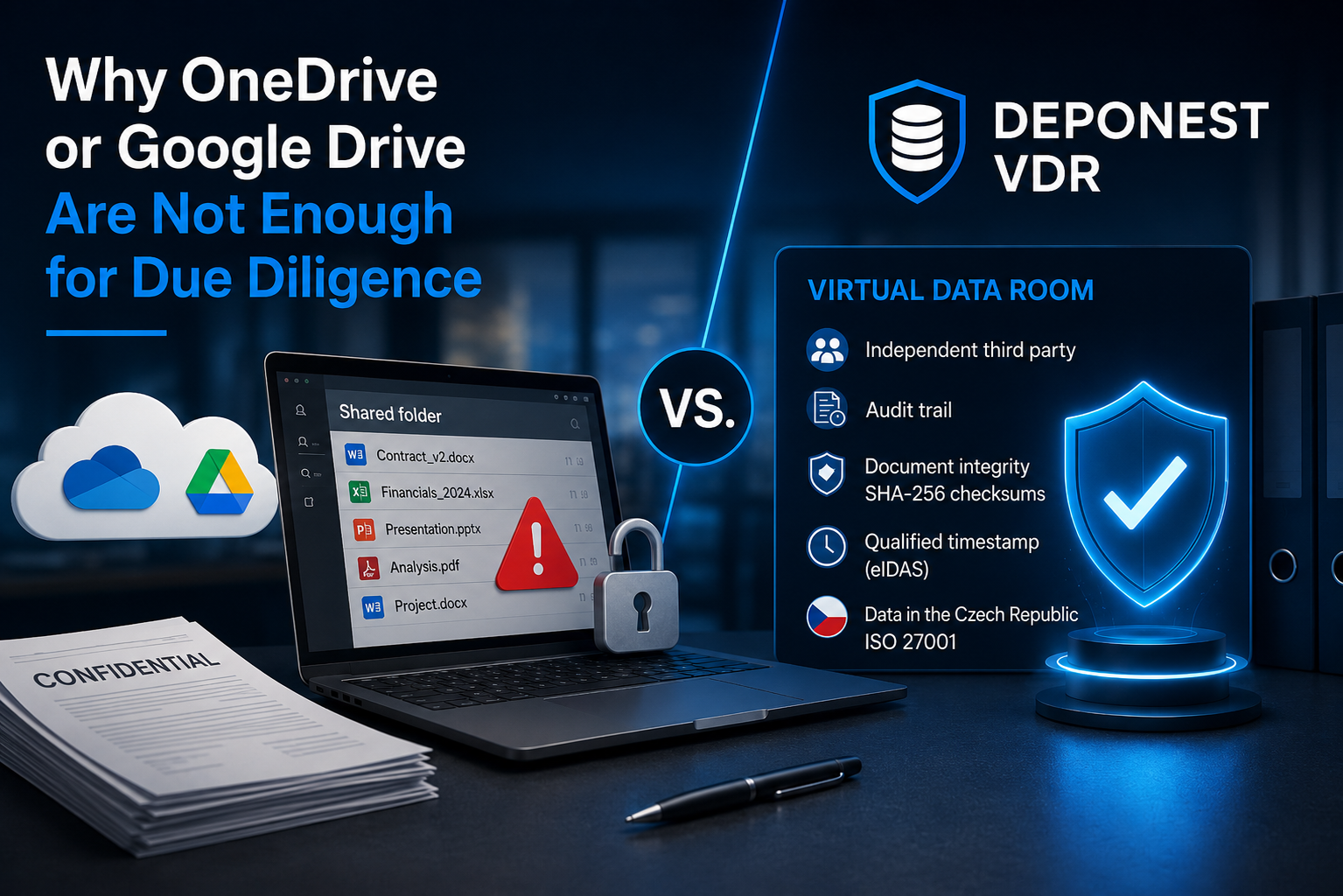
When a company is preparing, for example, for due diligence or an audit, the process usually looks simple at first. A shared folder is created in Google Drive or OneDrive, documents are uploaded, and the other party is granted access. For smaller-scale collaboration, this is a perfectly reasonable solution.
However, once sensitive documentation is involved, different questions arise beyond the convenience of file sharing. It is no longer only important whether a document can be opened or downloaded. The credibility of the entire environment becomes much more important.
The issue of an independent environment
If the data room is operated directly by one of the parties to the transaction, a natural question of trust arises. The system administrator may be able to modify, replace or delete documents. The other party may then find it very difficult to prove what was actually available in the data room at a particular moment.
This does not necessarily mean that anyone intends to manipulate the documentation. The mere possibility of such intervention may itself be a problem. This is precisely why sensitive transactions use Virtual Data Room systems operated by an independent third party.
Technical integrity of documents
Professional VDR systems do not only provide file storage. They also make it possible to verify document integrity retrospectively — in other words, to prove that a document has not been altered since a particular point in time.
This can be achieved using file fingerprints, known as SHA-256 checksums. Each document has its own unique digital fingerprint generated by a mathematical function. Even the smallest change to the file will result in a fingerprint that no longer matches the original version.
By regularly checking these fingerprints, the consistency of archived documentation can be verified retrospectively.
Timestamps and audit trail
Integrity verification combined with qualified electronic timestamps creates a significantly more trustworthy audit trail. It is no longer only a matter of what is in the data room today, but also of being able to demonstrate that a particular document existed in a specific form at a precisely defined time.
This may be important during due diligence, legal disputes or regulatory inspections. An audit trail supplemented by qualified timestamps can serve as significant supporting evidence of the state of archived documentation.
Data location and jurisdiction
With global cloud services, it is often not entirely clear in which jurisdiction the data is physically stored and which legal regime applies to it. This may complicate certain compliance requirements, for example in relation to the GDPR, the Czech Cybersecurity Act or NIS2.
Deponest operates its VDR infrastructure exclusively in the Czech Republic, in data centres certified to ISO 27001. Sensitive data therefore remains under Czech jurisdiction.
| Feature | Standard cloud storage | Deponest VDR |
|---|---|---|
| Data administrator | One of the parties | Independent third party |
| Document integrity | Possibility of undetected changes | SHA-256 checksums |
| Verifiability of history | Informational logs | Qualified electronic timestamps |
| Data location | Global (USA/EU) | Czech Republic, ISO 27001 |
Conclusion
Standard cloud services have their place and work very well for everyday collaboration. However, when documentation becomes more sensitive and trust needs to be established between multiple parties, file sharing itself is no longer the most important consideration.
What matters far more is the ability to demonstrate retrospectively what happened to the documents, who worked with them and whether their content remained unchanged. This is where the true value of a professional Virtual Data Room lies.